Why I Started Yet Another Chess Blog (Yes, Really)
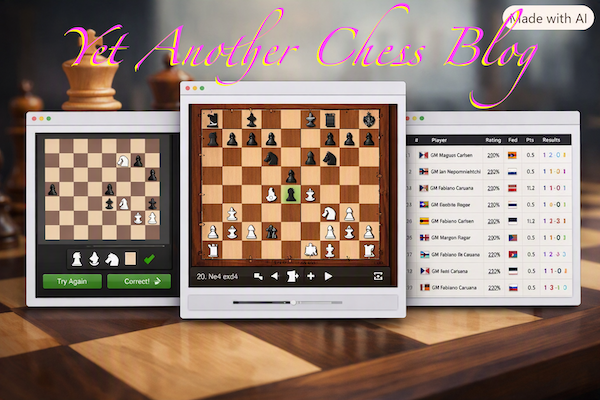
If you've followed my writing for a while, you already know I have a problem: I can't stop starting chess blogs. Over the years I've written on more than twenty different sites, platforms, and side projects, chasing whatever theme, audience, or itch I had at the time. So when I tell you I've started another one — this time at catur.org/blog — I understand if your first reaction is a raised eyebrow.
Fair. Let me explain why this one is different.
It's Not About the Writing — It's About the Tools
Every other chess blog I've run has been, fundamentally, just writing. Text, maybe a diagram screenshot, maybe a link out to a game viewer hosted somewhere else. Useful, but static.
catur.org started as something else entirely: a small collection of chess web utilities I built because I kept wanting things that didn't quite exist elsewhere in the form I needed. There's catur-replay for embedding playable chess games directly in a page, catur-maribelajar for interactive puzzles, and catur-results, which pulls in live tournament data from chess-results.com in a format that's actually pleasant to read. None of these are blog tools. They're just useful pieces of chess infrastructure I built for myself and decided to keep around.
The blog exists to sit on top of that infrastructure — not the other way around.
Same Domain, Real Advantage
This is the part that actually matters technically, so bear with me for a second.
Most of my old posts, when they included a game or a puzzle, had to embed it via an <iframe> pointing to some third-party tool. Iframes work, but they're clunky: they don't inherit your site's styling, they add an extra request and rendering overhead, and — this is the one that really bugs me — search engines generally don't treat iframe content as part of the parent page. So a beautifully annotated game sitting inside an iframe is, as far as Google is concerned, basically invisible.
Because catur.org/blog and the chess tools live on the same origin, I can skip the iframe entirely. I can fetch a game or a puzzle and inject it directly into the page's DOM, styled to match the rest of the post, indexed like any other content, with none of the cross-origin friction that comes from pulling in a widget hosted somewhere else. It's a small architectural detail, but it changes what a "chess blog post" is capable of being.
What That Actually Looks Like
Practically, it means a post here can:
- Embed a full, replayable game inline — not as a link out, not as a screenshot, but as something you can actually click through move by move without leaving the page.
- Drop in an interactive puzzle right in the middle of an article about tactics, instead of describing the position in prose and hoping you can visualize it.
- Pull in live results from an ongoing tournament and have them update as the event progresses, styled like the rest of the site instead of looking like a foreign object bolted on.
None of my other twenty-odd blogs can do this, because none of them were built alongside the tools they'd need to.
Look at other blog posts that contain chess games, interactive results and chess puzzles!
So, Another Blog — But a Different Kind
I'm not trying to replace anything I've written elsewhere. This isn't a "final answer" chess blog or a rebrand. It's the one place where the writing and the tools were built for each other from the start, and where an idea like "let me show you why this rook endgame is lost" doesn't have to stop at a diagram — it can become something you actually play through.
Leave a Comment